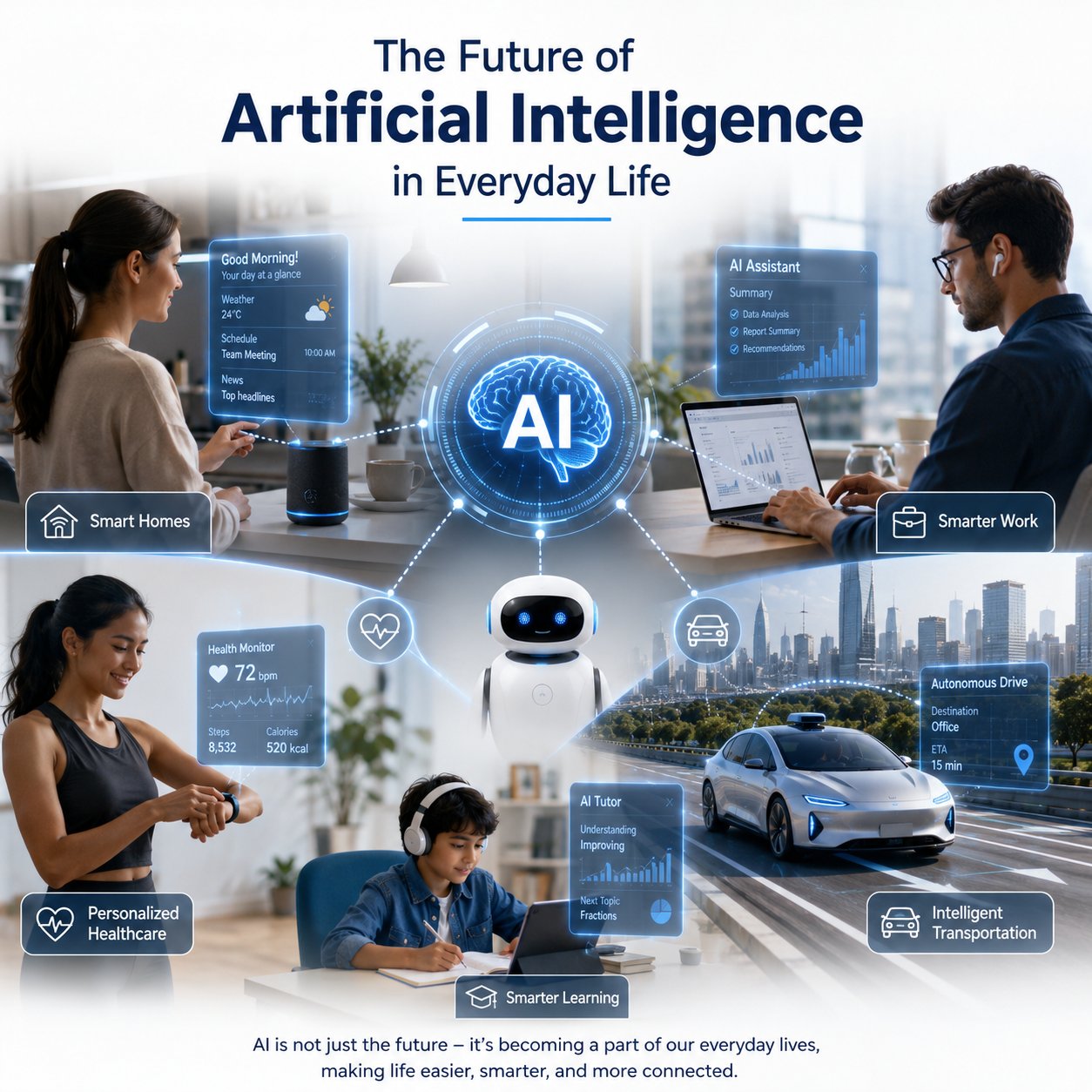
Artificial Intelligence (AI) is no longer just a futuristic concept—it has become an essential part of our daily lives. From personalized recommendations on streaming platforms to AI-powered virtual assistants and smart home devices, AI continues to reshape how we work, learn, shop, and communicate.
In 2026, AI adoption is expected to accelerate across industries, making technology more intelligent, efficient, and accessible than ever before. This article explores the latest AI trends, real-world applications, benefits, challenges, and what the future holds.
What is Artificial Intelligence?
Artificial Intelligence refers to computer systems designed to perform tasks that typically require human intelligence. These tasks include:
- Learning from data
- Understanding language
- Recognizing images
- Making decisions
- Solving complex problems
- Predicting future outcomes
Modern AI combines machine learning, deep learning, natural language processing (NLP), and computer vision to deliver intelligent solutions across various industries.
Why AI Matters in 2026
Businesses and consumers increasingly rely on AI because it helps:
- Improve productivity
- Reduce operational costs
- Automate repetitive tasks
- Enhance customer experiences
- Make data-driven decisions
- Increase business efficiency
Organizations of all sizes are integrating AI into their daily operations to remain competitive in the digital economy.
Top AI Applications in Everyday Life
1. Smart Virtual Assistants
Virtual assistants like Siri, Google Assistant, and Alexa have become smarter with advanced AI models.
They can:
- Schedule appointments
- Control smart home devices
- Answer questions
- Translate languages
- Set reminders
- Provide personalized recommendations
Future assistants will better understand context and natural conversations.
2. AI in Healthcare
Healthcare is one of the fastest-growing AI sectors.
AI helps doctors by:
- Detecting diseases earlier
- Analyzing medical images
- Predicting health risks
- Supporting diagnosis
- Automating administrative work
- Assisting in personalized treatment plans
Patients also benefit from AI-powered health monitoring through wearable devices.
3. AI in Education
Educational institutions increasingly use AI to personalize learning experiences.
Benefits include:
- Adaptive learning platforms
- AI tutors
- Automated grading
- Personalized study plans
- Language learning assistance
- Student performance analytics
Students can now receive instant feedback and customized learning paths.
4. AI in Business
Companies use AI to improve operations and customer service.
Popular business applications include:
- Customer support chatbots
- Sales forecasting
- Marketing automation
- Fraud detection
- Inventory management
- Document processing
AI enables organizations to make faster and more informed business decisions.
5. AI in Smart Homes
Modern homes are becoming increasingly intelligent.
AI powers:
- Smart thermostats
- Home security systems
- Smart lighting
- Voice-controlled appliances
- Energy optimization
- Automated cleaning devices
These technologies improve convenience while reducing energy consumption.
AI and Cybersecurity
Cyber threats continue to evolve, making AI essential for digital security.
AI systems help organizations:
- Detect suspicious activities
- Prevent cyber attacks
- Monitor network traffic
- Identify malware
- Reduce false alerts
- Respond to threats automatically
AI-driven security solutions significantly improve response times.
Benefits of Artificial Intelligence
Increased Productivity
AI automates repetitive work, allowing employees to focus on strategic tasks.
Better Decision-Making
Advanced analytics provide valuable insights from large datasets.
Cost Savings
Automation reduces operational expenses and minimizes human error.
Improved Customer Experience
AI delivers personalized recommendations and faster customer support.
Faster Innovation
Businesses can develop products and services more efficiently using AI-powered tools.
Challenges of AI
Despite its advantages, AI also presents several challenges.
Privacy Concerns
AI systems collect large amounts of personal data, making data privacy a major issue.
Job Automation
Some repetitive jobs may become automated, requiring workers to develop new digital skills.
Bias in AI Models
AI systems may produce biased outcomes if trained on biased datasets.
Ethical Considerations
Organizations must ensure AI is transparent, fair, and accountable.
Emerging AI Trends in 2026
Several exciting trends are shaping the future of AI.
Generative AI
AI can now create:
- Articles
- Images
- Videos
- Music
- Software code
Generative AI is transforming content creation and software development.
AI Agents
Autonomous AI agents can complete complex workflows with minimal human intervention.
Multimodal AI
Modern AI understands:
- Text
- Images
- Audio
- Video
This creates more natural human-computer interactions.
AI in Robotics
Robots powered by AI are increasingly used in:
- Manufacturing
- Warehouses
- Healthcare
- Agriculture
- Logistics
How Businesses Can Prepare for AI
Organizations should:
- Invest in employee AI training
- Adopt responsible AI practices
- Strengthen cybersecurity
- Improve data quality
- Identify automation opportunities
- Monitor AI performance continuously
Successful AI adoption requires both technology and skilled professionals.
Frequently Asked Questions (FAQs)
Is AI replacing human jobs?
AI mainly automates repetitive tasks. While some roles may change, AI also creates new opportunities in data science, AI engineering, cybersecurity, and digital transformation.
Which industries benefit most from AI?
Healthcare, finance, education, retail, manufacturing, logistics, and customer service are among the industries seeing significant benefits.
Is AI safe?
AI can be safe when developed responsibly with strong security, transparency, and ethical guidelines.
What skills are needed for AI careers?
Popular skills include Python, machine learning, data analysis, cloud computing, mathematics, and problem-solving.
Conclusion
Artificial Intelligence is transforming nearly every aspect of modern life. From healthcare and education to cybersecurity and business operations, AI continues to unlock new possibilities while improving efficiency and innovation.
As AI technology advances in 2026 and beyond, individuals and organizations that embrace continuous learning, ethical AI practices, and digital transformation will be best positioned for success. Rather than replacing humans, AI is becoming a powerful tool that enhances productivity, supports informed decision-making, and creates new opportunities across industries.