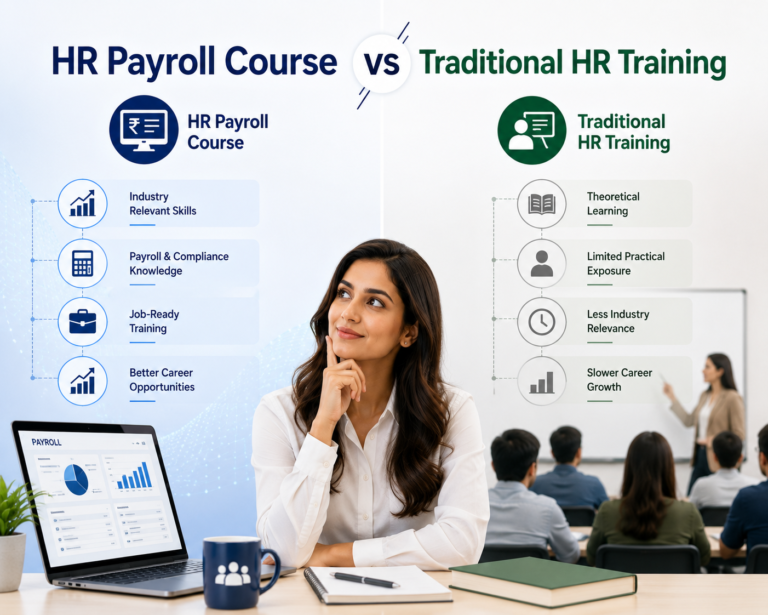
Payroll management has evolved significantly over the last decade. Traditional manual payroll processing is rapidly being replaced by payroll automation, enabling businesses to manage employee salaries, tax deductions, statutory compliance, and reporting with greater speed and accuracy. As organizations increasingly adopt digital payroll solutions, HR professionals need updated skills to stay competitive.
A payroll course online equips learners with practical knowledge of modern payroll software, statutory compliance, salary processing, and automation tools. Whether you’re an aspiring HR executive, payroll specialist, accountant, or working professional, enrolling in a payroll management course can help you build a future-ready career.
What Is Payroll Automation?
Payroll automation refers to the use of specialized software to automate salary calculations, tax deductions, leave management, employee benefits, and compliance reporting. Instead of manually calculating payroll each month, organizations now rely on integrated payroll systems that reduce human errors and improve efficiency.
Modern payroll software can automatically:
- Calculate employee salaries and overtime
- Process bonuses and incentives
- Deduct Provident Fund (PF), Employee State Insurance (ESI), and Professional Tax
- Generate payslips
- Calculate Income Tax (TDS)
- Manage attendance and leave records
- Generate statutory reports
- Ensure compliance with labour laws
As automation becomes standard across industries, professionals with payroll software expertise are increasingly in demand.
Why Payroll Automation Is Transforming HR Careers
Payroll is no longer limited to salary processing. HR professionals today play a strategic role in workforce management, compliance, employee experience, and business decision-making.
Automation allows HR teams to spend less time on repetitive administrative tasks and focus more on:
- Talent acquisition
- Employee engagement
- Performance management
- HR analytics
- Workforce planning
- Compliance management
This shift has created new career opportunities for professionals who understand both HR practices and payroll technology. Completing an HR payroll course enables candidates to handle modern payroll responsibilities while supporting broader HR functions.
Skills Employers Expect from Payroll Professionals
Companies now look for candidates who possess technical knowledge along with payroll expertise. Some of the most sought-after skills include:
Payroll Processing
Understanding salary structures, allowances, deductions, reimbursements, incentives, and final settlement procedures.
Statutory Compliance
Knowledge of:
- Provident Fund (PF)
- Employee State Insurance (ESI)
- Professional Tax
- Labour Welfare Fund
- Income Tax (TDS)
- Bonus and Gratuity
Payroll Software
Employers prefer candidates familiar with payroll applications such as TallyPrime, payroll management systems, and HRMS software.
Data Accuracy
Payroll professionals must ensure accurate salary calculations and maintain confidential employee records.
Compliance Reporting
Preparing statutory reports and ensuring organizations remain compliant with government regulations.
These skills are typically covered in a comprehensive payroll management course.
Why Choose a Payroll Course Online?
Online learning has made professional education more accessible than ever. A payroll course online allows learners to acquire industry-relevant skills without disrupting their current job or studies.
Some major advantages include:
Learn Anytime, Anywhere
Students and working professionals can access course materials at their convenience.
Industry-Oriented Curriculum
Most online courses include practical payroll scenarios, compliance updates, and software-based learning.
Hands-on Training
Learners gain experience processing payroll using real-world examples rather than only studying theory.
Certification
A recognized certification demonstrates your payroll knowledge and strengthens your resume.
Affordable Learning
Online courses are generally more cost-effective than traditional classroom programs.
Benefits of Taking an HR Payroll Course
An HR payroll course prepares learners for both HR and payroll responsibilities, making them more valuable to employers.
Some key benefits include:
- Better understanding of employee lifecycle management
- Improved payroll compliance knowledge
- Hands-on payroll software experience
- Enhanced salary processing skills
- Better career growth opportunities
- Higher employability across industries
Professionals with HR and payroll expertise are required in IT companies, manufacturing firms, retail businesses, healthcare organizations, educational institutions, and consulting companies.
Career Opportunities After a Payroll Management Course
Completing a payroll management course opens the door to various job roles, including:
- Payroll Executive
- Payroll Specialist
- HR Executive
- HR Payroll Executive
- Payroll Analyst
- Compensation and Benefits Executive
- Compliance Executive
- HR Operations Associate
- Payroll Administrator
As organizations continue investing in digital HR technologies, these roles are expected to remain in high demand.
How Payroll Automation Improves Business Efficiency
Businesses benefit significantly from automated payroll systems because they reduce operational costs while improving accuracy.
Key advantages include:
Faster Salary Processing
Payroll can be completed within hours instead of several days.
Reduced Errors
Automated calculations minimize mistakes caused by manual entries.
Better Compliance
Software automatically applies updated tax rules and statutory deductions.
Improved Employee Experience
Employees receive timely salaries, accurate payslips, and transparent payroll information.
Secure Data Management
Payroll systems securely store sensitive employee information while maintaining confidentiality.
Professionals trained through a payroll course online understand how to operate these systems efficiently.
Who Should Enroll in a Payroll Course Online?
A payroll course is suitable for:
- Fresh graduates
- Commerce students
- MBA HR students
- HR executives
- Payroll professionals
- Accountants
- Business owners
- Finance professionals
- Administrative executives
Even experienced HR professionals can upgrade their skills to stay aligned with the latest payroll technologies and compliance requirements.
Tips for Choosing the Right Payroll Course Online
Before enrolling, consider the following factors:
- Comprehensive payroll syllabus
- Latest statutory compliance coverage
- Practical payroll software training
- Industry-recognized certification
- Experienced trainers
- Hands-on assignments
- Placement assistance, if available
- Flexible learning schedule
Selecting the right payroll management course ensures you gain practical knowledge that employers value.
The Future of Payroll Careers
Emerging technologies such as Artificial Intelligence (AI), cloud-based HR systems, robotic process automation (RPA), and data analytics are reshaping payroll management. Payroll professionals are now expected to interpret payroll data, ensure compliance, and support strategic HR initiatives.
Instead of replacing payroll jobs, automation is transforming them into higher-value roles that require technical expertise and analytical thinking. Professionals who continuously upgrade their skills through an HR payroll course will be better positioned for long-term career growth.
Conclusion
Payroll automation has become an essential part of modern HR operations, creating exciting career opportunities for skilled professionals. Organizations seek candidates who can efficiently manage payroll systems, ensure statutory compliance, and leverage technology to improve payroll accuracy and employee satisfaction.
Enrolling in a payroll course online helps you develop practical payroll skills, gain hands-on software experience, and earn a certification that enhances your resume. Whether you are starting your career or looking to advance into specialized HR roles, a comprehensive payroll management course provides the knowledge and confidence needed to succeed in today’s digital workplace.
By investing in an industry-focused HR payroll course, you can stay ahead of changing workforce trends and build a rewarding career in payroll and human resource management.