Human Resource (HR) management has evolved significantly with changing workplace requirements. Earlier, HR professionals mainly focused on recruitment, employee engagement, and administration. Today, organizations require HR professionals who can manage advanced responsibilities such as payroll processing, compliance management, salary administration, and HR technology.
While traditional HR training provides knowledge of general HR functions, an HR Payroll Course focuses specifically on payroll operations and practical skills required to manage employee compensation accurately.
For professionals looking to build a career in HR, understanding the difference between traditional HR training and specialized payroll training can help them choose the right learning path.
Courses like Mastering Payroll Management with Tally help learners develop practical payroll skills, including salary processing, payroll software usage, and compliance management.
What Is Traditional HR Training?
Traditional HR training focuses on the broader aspects of human resource management. It provides knowledge about managing employees, workplace policies, and organizational development.
Some common topics covered in traditional HR training include:
- Recruitment and selection
- Employee onboarding
- Performance management
- Training and development
- Employee relations
- HR policies and procedures
This type of training helps professionals understand the overall role of an HR department and how it contributes to business growth.
However, traditional HR training may not always provide detailed knowledge of payroll processing, salary calculations, and payroll compliance, which are essential responsibilities in modern HR operations.
What Is an HR Payroll Course?
An HR Payroll Course is a specialized program designed to teach professionals how to manage payroll-related activities efficiently. It focuses on the practical aspects of salary processing, employee compensation, statutory compliance, and payroll software.
A payroll-focused course helps learners understand:
- Payroll processing steps
- Salary structure management
- Employee salary calculations
- Attendance and leave integration
- Tax and statutory deductions
- Payroll reporting
- Payroll software operations
The goal of an HR Payroll Course is to prepare learners with job-ready skills required for payroll and HR operations roles.
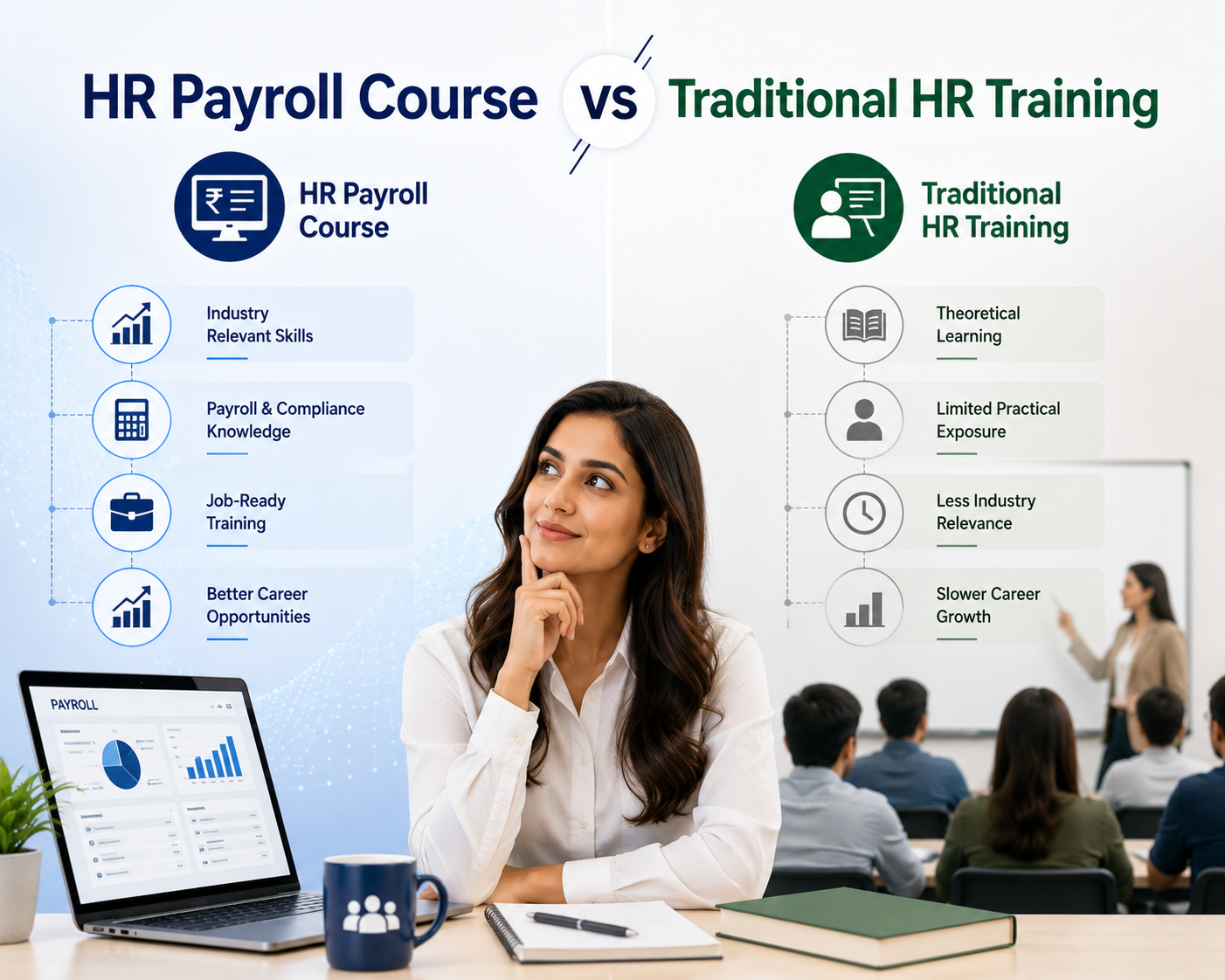
Difference Between HR Payroll Course and Traditional HR Training
1. Focus Area
The biggest difference between the two is their focus.
Traditional HR Training:
- Covers complete HR functions
- Focuses on people management and organizational processes
- Provides general HR knowledge
HR Payroll Course:
- Focuses specifically on payroll management
- Covers salary processing and compliance
- Develops technical payroll expertise
Professionals who want specialized payroll roles can benefit more from a payroll-focused course.
2. Payroll Processing Skills
Payroll is a critical function that directly impacts employee satisfaction and business compliance.
Traditional HR training may provide basic information about compensation management, but an HR Payroll Course Online provides detailed knowledge of:
- Salary calculations
- Earnings and deductions
- Payslip generation
- Payroll cycles
- Employee payroll records
These practical skills help professionals manage payroll operations independently.
3. Knowledge of Payroll Software
Modern organizations use technology to automate payroll processes. Understanding payroll software has become an important skill for HR professionals.
An HR Payroll Course introduces learners to payroll tools and practical applications, including payroll management using Tally Solutions.
Through courses like Mastering Payroll Management with Tally, learners can gain experience in:
- Employee master creation
- Salary configuration
- Payroll processing
- Generating payroll reports
- Managing payroll records
Traditional HR training usually focuses more on HR concepts rather than software-based payroll operations.
4. Compliance and Legal Knowledge
Payroll professionals must understand statutory requirements to ensure accurate salary processing and avoid compliance issues.
An HR Payroll Course provides knowledge about:
- Provident Fund (PF)
- Employee State Insurance (ESI)
- Professional Tax
- Income Tax deductions
- Payroll-related regulations
Traditional HR training covers HR policies broadly but may not provide in-depth payroll compliance knowledge.
5. Career Opportunities
Both HR training and payroll courses offer career opportunities, but the job roles can differ.
After traditional HR training, professionals can explore roles such as:
- HR Executive
- Recruitment Specialist
- Employee Relations Associate
- HR Generalist
After completing an HR Payroll Course, learners can apply for specialized roles such as:
- Payroll Executive
- Payroll Specialist
- HR Payroll Associate
- Payroll Administrator
- Compensation Analyst
Specialized payroll skills can help professionals stand out in competitive job markets.
Why Choose an HR Payroll Course?
Organizations need professionals who can manage payroll accurately while ensuring compliance with employment regulations. A specialized payroll course provides practical knowledge that directly applies to workplace responsibilities.
Benefits of learning an HR Payroll Course include:
1. Job-Oriented Skills
Learners gain practical payroll knowledge that can be applied in real workplace situations.
2. Better Career Growth
Payroll expertise can help HR professionals move toward specialized and higher-responsibility roles.
3. Software Knowledge
Learning payroll software improves efficiency and makes professionals more industry-ready.
4. Understanding Compliance
Knowledge of payroll rules helps professionals manage employee salaries accurately.
Why Learn Mastering Payroll Management with Tally?
A practical payroll training program helps bridge the gap between theoretical concepts and workplace requirements. Mastering Payroll Management with Tally provides learners with essential payroll knowledge along with hands-on software-based learning.
The course helps learners understand:
- Payroll fundamentals
- Employee salary management
- Payroll processing workflows
- Compliance requirements
- Payroll reports generation
- Practical payroll operations
This makes it suitable for HR professionals, accounting professionals, students, and beginners who want to develop payroll management skills.
Conclusion
While traditional HR training provides a strong foundation in human resource management, an HR Payroll Course offers specialized knowledge required for managing payroll operations effectively.
With businesses increasingly adopting payroll automation and requiring professionals with technical HR skills, learning payroll management can create better career opportunities.
If you want to strengthen your HR career with practical payroll expertise, a course like Mastering Payroll Management with Tally can help you develop the skills needed to become a confident and job-ready payroll professional.